How to turn large fillets into consumer-ready products?

Intelligent portioning ensures readiness for any trend

Woman Opening Fillet Pack

Across the poultry industry, one challenge keeps growing, literally. Chicken breast fillets have become so large that many processors struggle to turn them into products consumers actually want. In retail, foodservice, home-delivery meal kits and fast-food chains, the demand for consistent, easy-to-cook portions is rising. Meanwhile, individual fillets can now weigh 350 to 500 grams or more, making them too big for standard packs and difficult to cook evenly.

Consumers don’t want an oversized fillet that is thick in the middle and thin at the edges. When cooked, it often ends up overdone on the outside while still undercooked at the core. This market trend requires poultry processors to reconsider how they handle their raw material and creates new opportunities for value-added products.

Supermarket Fillets

From whole breast to ready-to-cook portions

In the past, breast fillets were sold as simple boneless, skinless pieces. But eating habits have changed. Today’s consumers expect ready-to-cook items such as cubes, strips, medallions, minute steaks or skewers. Many customers, especially younger generations, do not want to cut meat at home at all. They want to open a package, cook it quickly in a pan or air fryer, and enjoy a meal without extra preparation.
This is why equal portions become more important. Therefore consistency in cutting also becomes a key factor. Home-delivery meal kits, for example, receive complaints when portion sizes vary too much. Nobody wants to open a “meal for two” and find one large piece of chicken and one very small one. To maintain customer satisfaction, processors need accurate, repeatable cutting results. This is where intelligent portioning, using JBT Marel’s solutions, becomes essential.

Oversized fillets: challenge and opportunity

A large fillet is not a problem when you know how to process it well. In fact, oversized fillets can be turned into a range of high-value products, like medallions, minute steaks, stir-fry strips or cubes, split fillets,whole-muscle skewers, and finger-food-size tenders. All these products offer added value and meet modern consumer demands for variety and convenience.

Chicken breast fillets have become so large that many processors struggle to turn them into products consumers actually want.

I Cut DSI

Intelligent portioning unlocks new product ideas

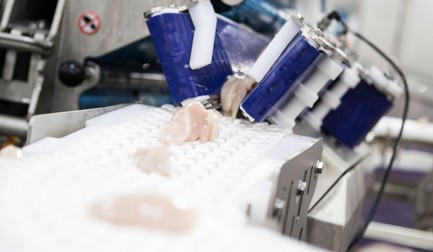
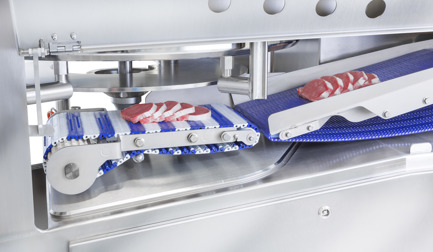
At JBT Marel, we support processors in transforming big fillets into attractive, profitable products. During workshops in our demo center, we use our portioning setup to test different cutting strategies with real poultry products from our customers. We segment the raw material by weight, explore portion sizes, and map out which products best match the customer’s needs.

Precise portioning with I-Cut blade cutting or DSI waterjet cutting technology makes it possible to create uniform, consumer-ready portions, while making maximum use of the large fillets. In this way, intelligent portioning can support a wide range of new product concepts with reduced giveaway and improved yield. This flexibility allows processors to adapt quickly to changing market trends, whether towards larger birds, slower-growing chickens, gourmet products or high-quality ready-to-cook meals.

Chicken Fast Food

1 / 1

Will fillets keep increasing in size?

In many markets, the growth of broilers is directly linked to production limits. For example, if a processing plant can run only a certain number of shackles per minute due to government regulations, the only way to increase throughput is by growing larger birds. This is why, in the USA specifically, fillets are getting heavier over time. At the same time, there is a growing trend for slower-growing chickens, like the Netherlands, where animal welfare is a priority. These birds are smaller, and their fillets are easier to handle and portion consistently, but production costs are higher and consumer demand can be lower due to the higher price. Processors need to be prepared for both trends: larger birds for higher efficiency and smaller, slow-growing birds for premium markets. Regardless of which direction the market takes, the challenge remains the same: how to portion consistently and create consumer-ready products from varying fillet sizes. Intelligent portioning systems allow processors to adapt quickly, handling both large and smaller fillets with precision and minimizing waste. Whether broilers continue to grow or not, flexible and accurate portioning is essential to meet market demands and consumer expectations.

Prepared for any trend

The poultry market will continue to evolve. Some regions focus on slower-growing birds; others push for more weight because line speed cannot increase due to governmental regulations. At the same time, fast-food chains face pressure to maintain portion sizes, and family restaurants turn to premium, gourmet menu items to compensate for rising ingredient costs.

Whatever trend takes over next, processors must make the best possible use of every fillet, no matter how large it is. More weight means more product options, provided you have the right portioning technology.

When using the JBT Marel SmartSplitter, RoboOptimizer, I-Cut 122 TrimSort or the DSI Waterjet Cutting Program, processors gain the flexibility to adjust quickly, create new product types, and deliver the consistent quality today’s and tomorrow’s consumers expect.


News

Get in touch

Our dedicated team is here to help and answer any questions you may have. Please complete the form, and we’ll get back to you as soon as possible. We look forward to hearing from you.

You can unsubscribe at any time. For more information on how to unsubscribe, our privacy practices and how we are committed to protecting and respecting your privacy, please review our privacy policy.

Login to get full access

Enter password to continue

Wrong password